3. Batteries
Estimate the amount of your pollution.
OUR EXPERIENCE
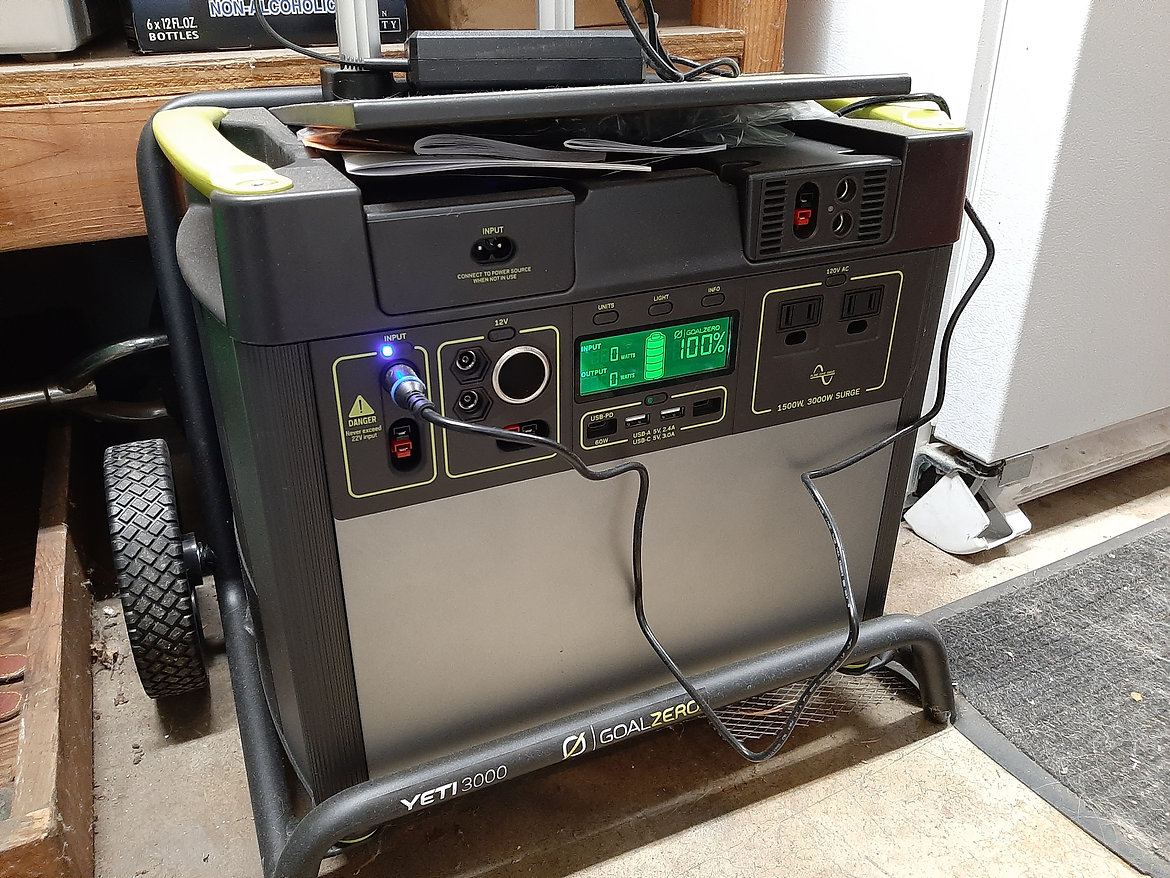
A few years ago, my wife and I bought two Goal Zero Yeti 3000 batteries. Each Yeti 3000 provides about 3,000 Wh of electrical “storage”, and now costs $3,400 (I do not recommend this battery today - see further below).
We chose the Yeti batteries because they’re portable, there’s no installation needed (just roll them out of the box and plug them in) and they provide plenty of electricity in case of a blackout.
We also didn’t want to disconnect from the electrical grid, as our municipal utility provides sort-of (see #4) 100% green/clean electricity.
What type of battery system you’ll want depends on what you’d like the batteries to do. We wanted basic back-up for an electrical power outage.
You might like plenty of electricity to run all your household stuff if/when the grid goes down. Even though we only wanted back-up, air conditioners (for a heat wave) and sump pumps (for minor flooding) require a big surge of electricity when they start up, so we got more than a small portable battery.
As you know, the sun may not be shining when the blackout happens, so we got enough battery storage to, hopefully, power essential gear without relying on electricity from the solar panels.
FUSE BOX
Whether it’s related to the solar panel installation, or getting other electrical items (see car, [house] (/solutions/house-electric)), you may need a fuse box upgrade (expansion of the main circuit breaker) to get your house wired for 220/240v - unless you have this already.
It’ll entail hiring an electrician, which isn’t inexpensive, and getting your utility to agree, which may go smoothly. With persistence, you should end up with a 21st century home electrical system - including code inspection - which’ll be better for wifi, family safety, real estate value, etc.
SOLAR PANELS PLUS BATTERY BACKUP
Since "it is a requirement for grid-tied (rooftop) systems to be off during a power outage,” you can “install an…inverter from SMA” that can cut your link to the grid at those times.
“‘SMA calls this feature Secure Power Supply’ (SPS),” which draws
- “power from panels even though…the grid is down”
- “…when [the] panels are absorbing sunlight."
Right, yes, ok, BUT, that is when you can use the batteries: when the sun is not shining!
Use the SPS to provide electricity when sunlight is hitting the roof; use the batteries when it’s dark out.
The more battery storage you purchase, the more prepared you’ll be for longer blackouts, and/or for the use of relatively more electrical appliances during shorter “power” outages.
One of the Yeti 3000 batteries kept our fridge/freezer going for 48 hours without getting any solar (or any other) additional input. In case of a serious blackout, we’ll have to ration what electricity we use based upon how long we expect the grid to be down. During the 1989 “World Series” earthquake (long before we had batteries or solar panels), our electricity was out for only 2 days.
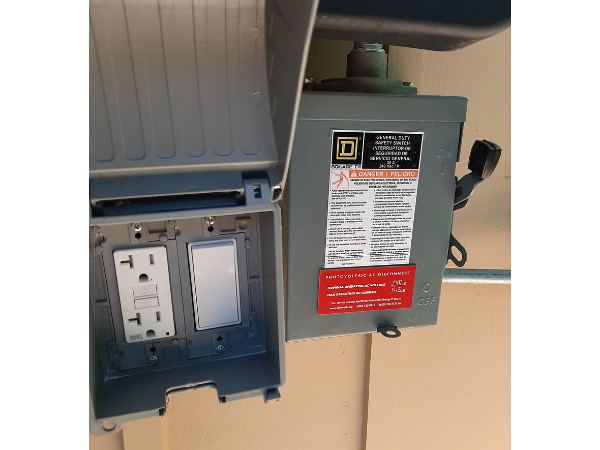
To re-cap, the plan is this: when the utility-provided electrical grid goes down, we have to flip a handle, push a button (see photo), and then we can plug in some appliances…if the sun is up.
At night, we use the batteries to get electricity. The next day the sun comes back up and we recharge the batteries with the solar energy…Unless it’s cloudy.
So far, when we’ve had blackouts for a few hours it worked like it should - fortunately.
BATTERY STORAGE BASICS
The Yeti batteries contain nickel and cobalt. LFP batteries are now available, and have fewer ethical sourcing problems (see further below).
Regarding the Nickel/Manganese/Cobalt (NMC) vs. Lithium/F(iron)/Phosphate (LFP) issue: “many…(battery) suppliers use LFP (including Discover, Eguana, Electriq Power, Enphase, KiloVault, SimpliPhi, sonnen).” “LFP batteries can be charged in half the time as NMC.”
BATTERY SHOPPING OPTIONS
“Comparing solar batteries can be challenging.”
These companies offer a battery system which requires professional installation, but has no cobalt or nickel: Enphase IQ Battery, sonnen eco, Electriq Power PowerPod 2, and SunPower SunVault. See this article from energysage for comparisons and recommendations.
For portable batteries (no installation needed):
- There’s big: from SimpliPhi - $13.2k
- And small: from Xantrex - $650
I do not endorse any particular product. Questions can be answered by local contractors/electricians.
ETHICAL / ENVIRONMENTAL CONSIDERATIONS
There are environmental and social problems with batteries. I would not buy an NMC battery (such as the Yeti) today.
Problems include:
- The pollution footprint of energy-storage
- Cobalt mining problems: Congo mining
- “Human rights, governance, equity, local environmental impacts”
- “Lithium mining is in need of much reform”
- “As with any resource extraction, there are environmental consequences”
Because of the cobalt and nickel source problems look for LFP (see above) batteries. For more suggestions, take a look at this ethical battery shopping guide.
Battery recycling holds promise: “Is battery recycling environmentally friendly?”
“Recycling must be proven to be more ecological than producing raw materials -
we can’t…assume recycling is automatically better.”
Finally, here’s two stories about battery recycling in the USA:
“Millions of EV’s batteries need an end of life solution.”
“How to Recycle Single-Use Batteries.”